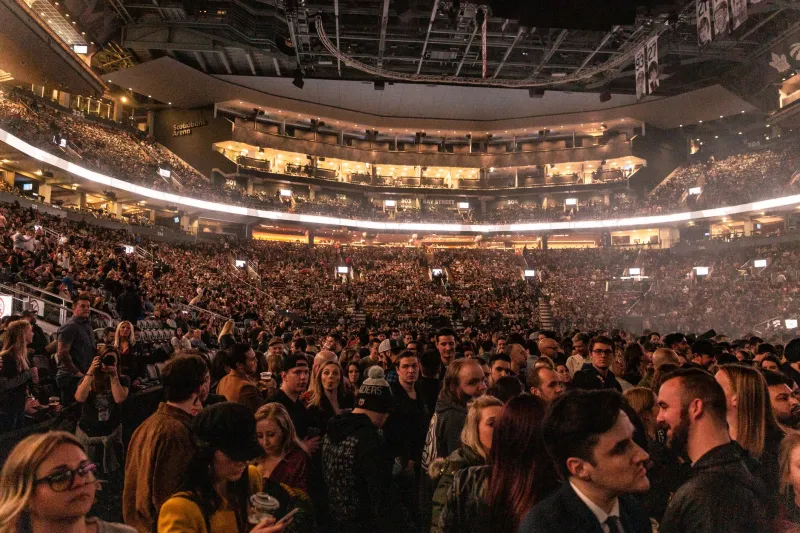
Showing Up Has a Price Tag: The Real Cost of Keeping Your Social Life Alive

Photo by Photo by Les Taylor on Unsplash on Unsplash
Let's say your friend texts you about a concert. A band you both genuinely love, a venue you've been meaning to visit, a Saturday night with no other obligations. You're in, obviously. You grab the ticket — maybe $75 after fees — and feel pretty good about yourself.
Then the rest of it happens.
Parking at the venue: $25. Drinks inside (because it's a special night): $40. The Uber home because you didn't want to deal with the garage at midnight: $22. The new jeans you bought because yours had a hole in the knee: $60. The babysitter: $80. The next morning's coffee and greasy breakfast because you didn't sleep until 2 a.m.: $18.
You just spent $320 on a $75 ticket. And you'd probably do it again next month.
This is what economists might call the total cost of participation — what everyone else calls just trying to have a social life.
The Ticket Price Is a Fiction
When we talk about event costs, we almost always focus on face value. It's the number that gets screenshotted and sent around the group chat, the figure that anchors the whole conversation. But that number is essentially a down payment on a much bigger bill.
A 2023 survey by Bankrate found that the average American spends around $3,000 a year on entertainment — and that figure doesn't fully account for the ancillary spending that surrounds live events. Transportation, food and drink, childcare, time off work, and wardrobe updates are rarely included in the math, yet they're often unavoidable.
For a major concert in a city like New York, Los Angeles, or Chicago, the full out-of-pocket experience can easily run $200–$500 per person once everything is factored in. For a destination bachelorette, a multi-day music festival, or a conference your colleague invited you to attend "for fun," that number can tip into the thousands.
And here's the thing: most people don't track it. They just feel vaguely broke after a good stretch of social events and wonder where their paycheck went.
The Friendship Tax Is Real — and It's Rising
There's an informal social contract embedded in modern American friendship: you show up. To the birthday party, the graduation brunch, the holiday market, the fundraiser your coworker is hosting. Attendance is currency. Absence is a statement.
But that contract was written before inflation hit concert venues hard. Before service fees became a second ticket price. Before gas, parking, and rideshare costs made getting across town feel like a financial decision.
The "friendship tax" — a term that's been floating around personal finance spaces for a couple of years now — refers to the cumulative cost of maintaining relationships through shared experiences. It's not just about big-ticket items. It's the $15 cocktail you didn't really want but ordered because everyone else did. It's the $12 Ticketmaster fee on a $30 show. It's the $50 in gas to drive two hours to see someone's band play their first real gig.
For people earning median wages or less, that tax can be genuinely prohibitive. According to the Bureau of Labor Statistics, the bottom 20% of American earners spend a disproportionate share of their income on entertainment relative to what's left after housing and food. When a night out costs $200 in all-in expenses, that's not a casual decision — it's a budget line item.
When Events Become a Class Divider
Event pricing has quietly sorted itself into tiers that map almost perfectly onto economic class. General admission is affordable but increasingly uncomfortable — standing for four hours, fighting for sightlines, waiting in lines that feel designed to push you toward an upgrade. VIP packages offer comfort and convenience but at prices that can run 3–10 times the base ticket. Premium experiences — early entry, artist meet-and-greets, backstage access — are priced entirely out of reach for most working Americans.
This tiering isn't inherently wrong. Organizers have real costs to cover, and premium offerings can subsidize more accessible pricing elsewhere. But the cultural effect is a quiet stratification of who gets to be in the room — and who gets to be in the good part of the room.
When a friend group spans different income levels, which they almost always do, event invitations can become awkward negotiations. The person who can afford floor seats doesn't always want to say so. The person who can't afford them doesn't always want to admit it. The result is a lot of polite declining, vague excuses, and slowly drifting social circles.
What Organizers Can (and Should) Do About It
None of this is entirely the organizer's fault — and some of it is genuinely outside their control. Venue costs, artist fees, insurance, and staffing have all climbed sharply in recent years. Passing some of that along to attendees is unavoidable.
But there's a growing conversation in the events industry about what responsible, inclusive pricing actually looks like. A few approaches gaining traction:
Transparent all-in pricing. Some platforms and organizers are experimenting with showing the full ticket cost — including fees — upfront, rather than revealing the real number at checkout. It builds trust and reduces the psychological bait-and-switch that frustrates so many buyers.
Sliding scale and pay-what-you-can tiers. More common in the arts and nonprofit space, this model acknowledges that not everyone can pay the same price for the same experience. It's not a perfect solution, but it signals something important about who an event is actually for.
Early bird pricing with real deadlines. Rewarding people who plan ahead — and keeping those prices genuinely accessible — helps budget-conscious attendees make decisions without the last-minute premium.
Bundled convenience. Some larger events are starting to offer parking-included or transit-partnered ticket packages that reduce the hidden cost burden. It's a small thing, but it matters.
The Math Nobody Does Before They Say Yes
Here's a rough back-of-the-napkin breakdown of what a single evening out can actually cost an American attending a mid-tier concert in a major city:
- Ticket (with fees): $85–$120
- Transportation (rideshare or parking): $20–$50
- Drinks at the venue: $30–$60
- Dinner or food before/after: $25–$50
- Childcare, if applicable: $60–$100
- Outfit or grooming: $0–$75
Total realistic range: $220–$455
For a household making $60,000 a year — roughly the US median — that's nearly a full week of discretionary spending on one night.
None of this means people should stop going to events. If anything, the data makes a case for how much people value live experiences — enough to stretch their budgets, rearrange their schedules, and show up even when it's inconvenient. That's a remarkable thing.
But it does mean the industry has a responsibility to acknowledge what attendance actually costs — and to build pricing structures that don't quietly price out the people who want most to be there.
Showing up for your people matters. It shouldn't require a financial sacrifice every single time.