Blink and You'll Miss It: The Rise of the Micro-Event and What It Means for Organizers
Photo: Andres Rodriguez, CC BY-SA 2.0, via Wikimedia Commons
Ask anyone who books events for a living what keeps them up at night, and Gen Z will eventually come up. Not because younger audiences are uninterested in live experiences — ticket sales data consistently says otherwise — but because the format that worked for the past thirty years is starting to feel like it's speaking a language this generation only partially understands.
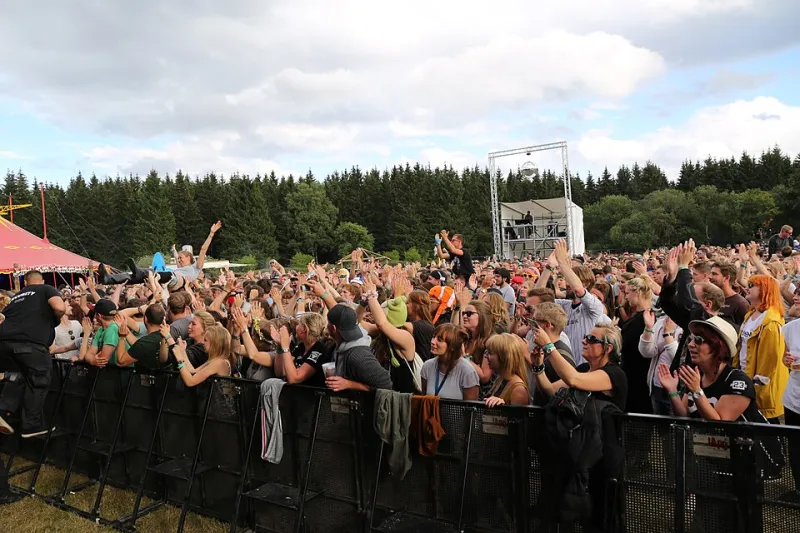
The three-hour arena show. The all-day festival. The keynote-plus-panels conference. These formats were built for an era of different attention rhythms, different social habits, and frankly, different phones. What's emerging in their place is something faster, more modular, and genuinely more interesting to design — if you're willing to rethink what an event actually is.
The Attention Economy Is Not Theoretical
Let's be honest about what we're dealing with. TikTok's average video length hovers around 30 seconds. Instagram Reels that perform best are under 15. YouTube Shorts. Snapchat. The content landscape that Gen Z grew up in is built around compression — making something meaningful happen in the smallest possible window.
This doesn't mean Gen Z has short attention spans in some clinical sense. Research from the University of British Columbia found that younger adults are perfectly capable of sustained focus — they're just highly selective about where they direct it. They've been trained by years of algorithmic content to make fast, accurate judgments about whether something is worth their continued attention.
Bring that mindset to a live event, and the implications become obvious fast.
"We noticed our drop-off in attendance wasn't at the start of events — it was around the 90-minute mark," says Priya Okafor, who organizes creative industry gatherings in Brooklyn and Los Angeles. "People weren't leaving because they were bored with us. They were leaving because they'd gotten what they came for and the programming kept going anyway."
What Micro-Events Actually Look Like
The term "micro-event" covers a lot of territory, and that's kind of the point. It's less a rigid format and more a philosophy: design for peak moments rather than total duration.
In practice, this looks like a lot of different things. Thirty-minute pop-up DJ sets in unexpected urban spaces. Brand activations that run for a single weekend with a deliberately limited guest list. "Dinner drops" — intimate chef experiences announced 48 hours in advance with ten seats available. Art installations that exist for 72 hours and then disappear, documented entirely by the people who showed up.
In Austin, a collective called Fomo Club has built an audience of over 40,000 followers by hosting events that last, at most, two hours — often less. Their formula: one location, one vibe, a hard start and a hard end. No lingering, no awkward wind-down. The constraint itself has become part of the brand.
"When people know it's ending, they actually show up on time," says one of Fomo Club's founders. "That's the dirty secret. Open-ended events make people late. Finite events make people early."
The Shareable Moment as Core Product
Here's what connects every successful micro-event format: they're engineered around a specific moment that's worth sharing. Not the whole experience — the moment. The reveal. The unexpected detail. The thing that makes someone pull out their phone.
This is a fundamental reorientation of how events create value. Traditional event design asks: how do we keep people here as long as possible? Micro-event design asks: what's the one thing people will talk about tomorrow?
For organizers, that shift requires a different kind of intentionality. You're not filling time — you're building toward something. Every element of the event exists to set up that central shareable moment, whether it's a performer's surprise appearance, a visually overwhelming installation, a guest speaker who drops something genuinely unexpected, or a product reveal that nobody saw coming.
When that moment lands, it doesn't just satisfy the people in the room. It travels. And in an era when organic social reach is the most valuable marketing currency an event can generate, a two-hour experience that produces 10,000 pieces of authentic user content is worth more than a six-hour extravaganza that people quietly forget.
What Organizers Are Getting Wrong
Not everyone is threading this needle well. The most common mistake is treating micro-events as budget events — cutting content, cutting production value, cutting staffing, and calling the result a "curated experience." Gen Z audiences are remarkably good at detecting that kind of cynicism, and they will absolutely put you on blast for it.
The second mistake is ignoring the modular opportunity. Longer events don't have to be abandoned entirely — they need to be restructured. Think of a three-hour conference not as one long thing but as three distinct one-hour experiences that happen to share a venue. Give each segment its own identity, its own energy arc, its own reason to be there. Build in genuine breaks that feel intentional, not like filler.
Several major conference organizers have started experimenting with what they're calling "choose your own schedule" formats, where attendees build a personalized two-to-three hour itinerary from a menu of simultaneous sessions, activations, and social spaces. The total event might run six hours, but no individual attendee experiences more than they want to.
Practical Moves for 2025 and Beyond
If you're an organizer trying to adapt without blowing up everything that's worked for you, here are a few places to start:
Audit your programming for dead time. Watch footage from your last event. Identify the moments when energy visibly drops. Those are your targets.
Build a peak moment, then work backward. Decide what you want people to share, then design the entire experience to support that moment. Don't let the peak moment be an accident.
Experiment with hard end times. Announce them publicly. Watch what happens to arrival behavior and energy levels.
Consider serialization. Instead of one big annual event, could you run four smaller ones? Recurring micro-events build habit, community, and anticipation in ways that annual formats struggle to match.
Talk to your younger attendees. Not in a focus group — at the event. Ask them what they almost skipped. Ask them what made them stay. The answers will surprise you.
Gen Z isn't the enemy of live events. If anything, they're the generation most hungry for genuine human connection in a world that increasingly offers them digital substitutes. They just want that connection delivered efficiently, authentically, and on terms that respect their time.
Meet them there, and you'll find an audience that shows up early, stays fully present, and tells everyone they know. That's not a bad trade for rethinking your run-of-show.