Accessible on Paper: Why the Checkout Still Fails Disabled Fans
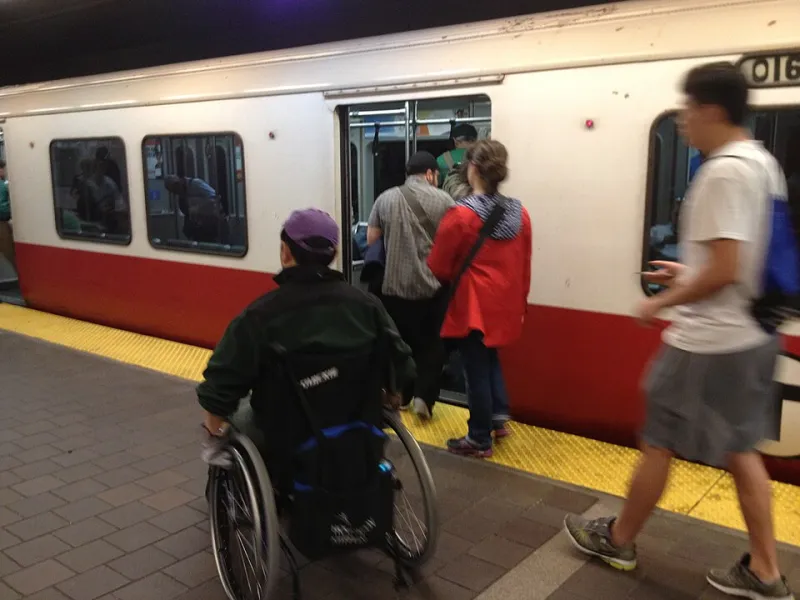
Photo: ArnoldReinhold, CC BY-SA 3.0, via Wikimedia Commons
Ask a wheelchair user in any major U.S. city how they buy concert tickets and you'll usually get the same story, delivered with a tired laugh. The show goes on sale at 10 a.m. sharp. Their friends hop on at 9:58, queue up, and by 10:04 they've got four seats in Section 112. Our fan — call her Dana, a 34-year-old paralegal in Chicago — is still on hold.
Because the accessible seats weren't in the online map. They weren't in the app. The only path was a phone number that opens at 10 a.m., closes at 4 p.m., Monday through Friday, and is staffed by one person who is also answering questions about parking passes.
Dana works weekdays. She got through at 11:40. The seats were gone.
The compliance box is checked. The experience isn't.
Nobody in that story is breaking the law in an obvious way. The Americans with Disabilities Act has required accessible seating since 1990, and the 2010 Standards are specific: accessible seats must be dispersed across price tiers, integrated with general seating rather than tucked into a corner, and sold with companion seats beside them.
On paper, almost every American venue passes. In practice, compliance lives in the seating chart while the failure lives in the checkout flow.
The gap isn't philosophical. It's operational, and it shows up in four predictable places.
Four places the pipeline breaks
The inventory is hidden. Accessible seats frequently sit in a separate pool that never surfaces on the interactive map. Fans can't see them, can't compare them to nearby price tiers, and can't tell whether they're sold out or simply not displayed. A sold-out sign that means "we didn't put them online" is the single most common complaint advocates hear.
The verification gauntlet. Some venues still ask buyers to document their disability at purchase. The law doesn't require that, and the Department of Justice's guidance on ticket sales encourages venues to sell accessible seats through the same channels and at the same time as everything else — not to funnel people into a proof-of-disability interview to buy a ticket to a cover band.
The companion problem. Companion seats are supposed to be sold alongside accessible seats at the same price. In reality, fans report being told the companion seat must be purchased in a separate transaction, that it's unavailable for a specific show, or that it can only be arranged "subject to approval" closer to the date. That's a dignity tax, and it lands hardest on people who already had to make three phone calls.
The day-of gap. Even a clean purchase can collapse at the gate: an accessible entrance that isn't the one on the map, a staffer who doesn't know where the elevator is, a lawn section with a slope nobody mentioned. Great ticketing can be undone by ten minutes of bad wayfinding.
The organizers quietly rebuilding it
Some of the most useful work right now is coming from small teams, not stadium-scale operators.
Accessible Festivals, a nonprofit that has consulted on accessibility planning for major U.S. events, pushes organizers toward publishing accessibility maps and sensory guides before the sale — so a fan can decide whether a show is workable before they spend money on it. Half Access built a crowd-sourced database of venue accessibility details precisely because official information is often thin or outdated. And a growing number of independent promoters have started treating "access needs" as a standard checkout field, the same way they treat parking or merch bundles.
The pattern across all of them: move accessibility from a special-requests desk to the default path.
Fixes hiding in plain sight
None of these requires new legislation. Most require a ticketing configuration change and an hour of staff training.
- Put accessible inventory on the same map, at the same moment, at the same price tiers. If a seat is buyable, it should be visible.
- Bundle the companion seat at checkout. One transaction, one confirmation email, no follow-up phone call.
- Keep a phone line — but staff it during the onsale. A human option is a genuine accessibility need for plenty of fans. It just can't be the only door, and it can't be closed when demand peaks.
- Publish the real map. Entrances, restrooms, elevators, sightlines, surface material, where the shade is. Update it every season.
- Give staff a script and a direct line. Door crew should know the accessible route cold and have someone to call when something's locked.
- Offer a relocation-or-refund guarantee. If the accessible seat turns out to be unusable, the fan shouldn't have to argue about it from the concourse.
What good actually looks like
It looks boring, honestly. An interactive map where the wheelchair icon sits next to the seat you'd actually want. A checkout that asks one question and remembers the answer. A confirmation email with a photo of the entrance. A gate team that doesn't have to radio anyone.
The venues that get this right tend to report something unexpected: it doesn't just serve disabled fans. It serves the parent with a stroller, the guy on crutches, the grandmother who can't do stairs anymore, the friend who sprained an ankle two days before the show.
Accessibility isn't a niche. It's a preview of everyone's future, and the ticketing systems that treat it as an afterthought are quietly telling a big chunk of their audience that the doors were never really built for them.
The fix has been sitting in plain sight the whole time. It's just a checkbox nobody clicked in the admin panel.